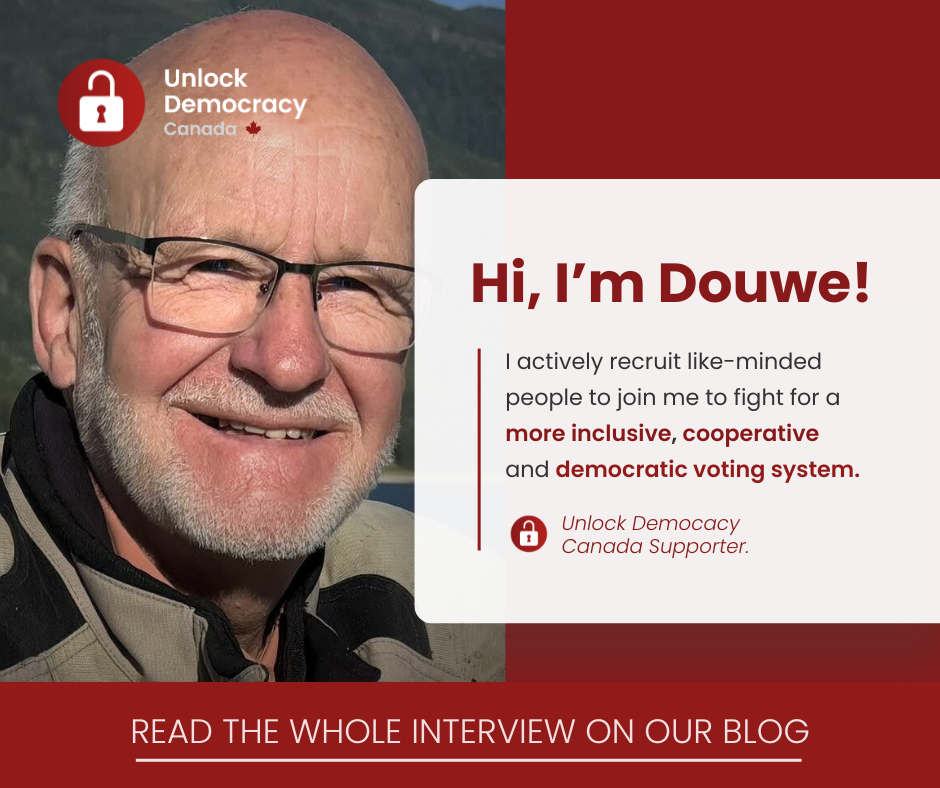
An interview with a supporter: Douwe Spriensma, Board member of Fair Vote Edmonton
We interviewed one of our recent supporters for our Civics Education Campaign: Empower the Next Generation - A Radical Shift in Civics Learning to learn more about his motivation to support our work. The following piece was written based on our conversation. We hope it will inspire you as much as it inspired us.
What first got you into the movement for proportional representation?
I grew up in the Netherlands, where proportional representation was simply the standard political system. My father was involved in local municipal politics, but at the time I didn’t think much about how the voting system influenced decision-making. When I moved to Canada, I experienced a different political culture. Over time, I observed that the decision-making structures here tend to be more adversarial.
From my perspective, the incentives facing politicians in Canada at times create tension between representing voter preferences and aligning with party positions. In first-past-the-post systems, party discipline, strategic positioning, and the need for party approval influence how elected officials act. Typically, politicians win with less than fifty percent of the total votes. This leaves many voters with the impression that they’re not represented.
What is the difference with a proportional representation system, like in the Netherlands?
Numerous political parties compete, and no single party typically receives a majority of the vote—it’s usually around 20 percent or less. As a result, parties need to collaborate and form coalitions to govern. Because voters can choose from a wide range of parties, elected officials tend to face stronger pressure to align with the positions they campaigned on. Voters can shift their support to another party if they feel their views are not being represented. Each vote counts.
Coalition governments require negotiation among multiple parties. This often broadens the range of perspectives included in policymaking, and it requires compromise and stability across party lines.
In contrast, with Canada’s first-past-the-post system political debate often is polarized, and majority governments can be formed without a majority of the popular vote. This creates an adversarial system.
How did you get involved with Fair Vote Canada?
What motivated me was a sense that the voting system did not always reflect the diversity of public preferences. I think democratic institutions should serve the broader community and include a variety of viewpoints. A conversation with my sons about their suggestion to concentrate political authority prompted me to reflect more deeply on the nature of democratic decision-making and why one-party rule can be risky.
That led me to support Fair Vote Canada’s Edmonton chapter. My belief is that having multiple perspectives involved in governing strengthens decision-making. I’m also concerned about the influence of lobbying and other external pressures in shaping policy, and I value efforts aimed at increasing transparency and broadening representation.
What is a major obstacle to instituting proportional representation?
Awareness. Most voters don’t know there are better options available. One challenge is that electoral reform often requires political parties—especially those currently in government—to support changes that may reduce their future ability to win control. Party members or local representatives may favour proportional representation, but party leadership often hesitates because it could require future coalition governance or diminish the strategic advantages they want to keep.
For example, although the Alberta NDP expressed interest in proportional representation, it did not pursue electoral reform after forming government in 2015. Similar patterns occur in other jurisdictions: once a party gains power under the existing system, electoral reform becomes a lower priority.
Why did you choose to support the Civics Education Campaign from Unlock Democracy?
Changing the electoral system starts with education, showing how things can be better in the future. I believe that understanding how different voting systems function is important for young people. In my view, Canada’s current electoral outcomes can at times concentrate power in ways that don’t fully reflect overall voter preferences.
Classroom activities—such as voting on lunch choices—can illustrate the difference between first-past-the-post and proportional approaches. If 30 per cent of students vote for pizza, and the other 70 per cent vote for other options, pizza will "win," and that hardly seems fair. These exercises can help students identify how representation works and how different systems value votes in different ways.
My hope is that future generations will build a deeper understanding of the democratic process and consider the importance of changing Canada’s system. Unlock Democracy’s Civics Education program supports this goal.
Douwe Spriensma is a Board member of Fair Vote Canada’s Edmonton Chapter and a passionate advocate for proportional representation in Canada.
If you, like Douwe, believe in the power of education to transform our democracy, we invite you to support our work by donating to our Civics Education Campaign — you’ll even get a charitable donation tax receipt!